
I see at least two main approaches to building a pit house with earthbags:
1. Mimic Mike Oehler’s greenhouse design using earthbags instead of poles and shoring.
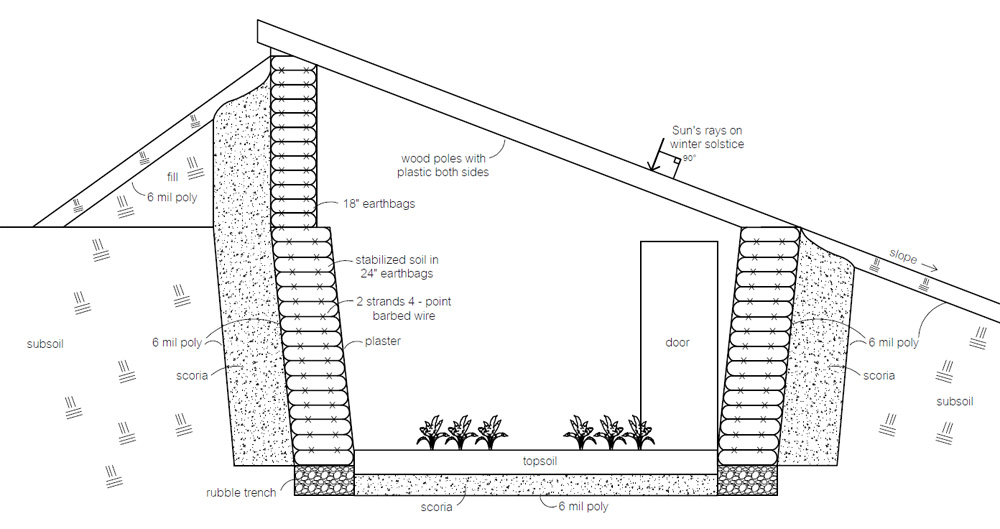
2. Mimic conventional walipini pit greenhouses. That’s what I’ve chosen to do in the following drawing. It’s very similar to typical walipini’s, so follow the directions in the link. Which one is best? It would be good to build both designs and measure their performance to see how they compare.
Related:
Earthbag Pit Greenhouses
Note: high quality greenhouse plastic film is recommended, not ordinary plastic sheeting.
idea 2: less digging needed, but less plant space. Is this the better plan? And is the insulation okay?
I would say that one plan is not better than the other; they each have trade-offs. Oehler’s plan is not insulated, so the second plan has the potential to retain more heat, and that could be a factor in many climates. Oehler’s plan has been tested, but I am not sure about Owen’s Walipini plan.
I have 2 questions.
1) Can I use the soil excavated from the pit to fill the bags or do I need a specific mix of gravel and dirt? I think we have a silt based soil in my yard. Also, do you add cement to your mix?
2) How do I attach the roof beams? I will need to use a dual walled polycarbonate roof to withstand the wind and local deer population, so I need a roof that can be well secured. How would you go about that?
Appreciate your thoughts!
All you need is enough clay and moisture to form a strong earthbag block. Most any soil will work. Always experiment first. To hold the roof on you need a bond beam. Wood is the cheapest and easiest. Both questions are answered repeatedly on this blog. Use the search bar on the right side of the page, check the FAQ page and if you’re actually going to build then buy my ebook for full step by step details. It’s all simple, but there’s a learning curve to everything. Also, it will probably help to get an illustrated carpentry book from the library to help with the roof, doors, etc.
I live in South Australia. Our soul is ‘dirt’; primarily silicate and chalk heavy rock. I have created “trench beds” for gardening as the natural sheets of chalk do a very god job of both isolating the fertile soil from the sandy soil past the beds, as well as allowing drainage. We have winters with enough rain to provide gardens (but too much cold so micro-climates are needed) as well as summers that are too hot (with very little rain) and so shade cloth is a necessity … as are drip watering systems. We have rain tanks so we can establish our baby plants as our ground water is a bit too saline for baby plants (and this does reduce harvest quantities). I have been considering a Walipini system that uses plastic sheeting in the winters and shade cloth in the summers. None of the FAQ/tutorials I have found are for my climate and soil (then tend to assume clay or loam and life in North America). Advice would be helpful.
Contact your local agricultural office or university.
Hi
I am looking for a way to build a ROOT CELLAR. I live in middle Georgia. Hot summers, short frosty winters with a month of; off and on freezing nights in Jan. its spring by Feb(sometime)-March(usualy) it’s frost free.
EARTH BAG ROOT CELLAR or ADOBE ROOT CELLAR. seeing we have solid clay ground here i would like to us that clay for the building of a root cellar. i was thinking of one with a roof top, Planting a fast growing tree to shade it. We don’t have any shade in the yard at the moment near the hill that i want to put a root cellar. its right out the back door, close to the kitchen, into an embankment.
I can’t find any info on this, so i think it can’t be done, but i have to ask. Thank You, Sandy
Is that possable?
Almost any kind of simple structure can be made with earthbags. Just imagine all the bunkers and machine gun fortifications the militaries have built over the years. Search our blog for root cellars, pantries and shelter plans. There’s one doc on our Free Plans page of desert shelters also.
I wonder if this would work in the humidity of the Philippines…
You don’t need greenhouses in the tropics. This one in particular is for very cold climates.
actually in extremely hot climates, there can be days that are just too hot for certain crops. For example I have friends in Virginia USA who cannot grow strawberries in summer, it’s just too hot.
I’m imagining it’d be helpful to keep a log book of weather & temperatures outside and inside the walipini, and the plants grown those years, & compare results.
In far northern climates one may want a double-door to keep the walipini’s inside temp more even when you go in & out; &/or maybe plan to plant cooler plants like lettuce closer to the doorway & plants needing warmer temps like carrots farther from the door. Just a couple thoughts.
Good ideas, thanks.
Thanks Owen! The rough opening now is 40’x60′, taking into consideration room for the bags and stone backfill. I’m thinking around 30’x50′ finished. The walls will be between 6′-8′ high to ground level.
Jim
Hello Owen,
Getting ready to excavate for the Walipini.
Quick questions:
Do the corners of the walls need to be extended out for buttressing?
Do you need a bond beam before connecting roof?
Thanks
Jim
The walls are partially underground, right? If so then the earth or earth berm provides adequate buttressing.
Bond beams are important for tying walls together and securing the roof. Depending on the size, budget, etc. you might get by using 2x6s spiked into the bags with rebar that’s bent over the last few inches.
This is awesome. Underground green house. I thought two ways to cool down in summer. Roll shade cloth over top. Hand cranking would work. In summer clean out fireplace, insert fan to blow warm air outside. FYI :)
Good ideas, thanks.
Thank you so much for your reply. To elaborate a little more on my design I just want to reiterate the fact that the bulk of this structure will be underground (not sure if this has any effect on the design). I had considered the use of rebar pinning and buttresses. My concern with the buttresses is with their orientation. Will they face inward (towards the inside of the structure) or outward to brace the wall against the push of the earth behind it? I haven’t been able to find very much information on underground building with earthbags so any information will be greatly appreciated. My hope is to build a small commercial greenhouse that is 100% energy self sufficient (primarily using solar for electricity). Thank you again.
What you’re describing is certainly possible. You’ll have to find a local engineer, architect or designer who’s familiar with the soil and other important facts in your area. There are lots of ways of doing things…
I was wondering if anybody had put any thought into the maximum size of a earthbag pit greenhouse. I’m a beginning farmer and have been putting a lot of time and research into starting a large scale pit greenhouse, something in the range of 30-40×80′. Is there any literature out there on the structural integrity of a greenhouse this large built from earthbags? If not what are your opinions.
There’s no size limit if it’s designed and built correctly. You could build it as large as you want. But you have to understand how to work with earthbags. For instance, there’s often support (post, buttress, etc.) every 12 feet or so on long straight walls. You have to think about how the roof load with sit on the walls. Will the rafters push the wall in or out? You might want to include some rebar pinning and/or a concrete bond beam along the top of the wall to tie the bags together.
I wrote a review of Mike Oehler’s book that you can read at http://greenhomebuilding.com/articles/earth-shelteredgreenhouse.htm
I think that it is an excellent concept, especially for cold northern climates; in fact I plan to make one for my little homestead, using earthbags. According to Mike having the cold sink is critical to the success of the plan.
With the walipini plan that Owen shows, without substantially raised beds, much of the floor area would not receive enough sun in mid winter where I live.
Follow the guidelines in the Benson Institute PDF. The design I’m showing mimics the one in Bolivia. They explain how to adjust it for various regions.
We are looking at using earthship design for our greenhouse project. Using old earth packed tires rather then earthbags would have more thermal mass storage. It will also have a cistern in the back berm for water catchment so the greenhouse will be self sufficient water wise, or as much as possible. We’re putting our plans together for the project next summer. In our winters, East Coast Canada, we need to put a thermal wrap behind our thermal mass wall and floor to help keep in the heat. Should be a fun project… Google earthship to check out these spectacular self sustaining homes.
I like the idea of adding a cistern next to the greenhouse. Have you heard of earthbag earthships? People recognize the excellent design of earthships, but now they’re starting to build them out of earthbags because they’re faster and easier to build. Use 24″ wide bags and you’ll have almost exactly the same thermal mass.
http://earthbagbuilding.wordpress.com/2010/11/06/half-moon-earthbag-earthship/
http://earthbagbuilding.wordpress.com/2011/08/08/3342/
I remember something written about that cold channel. While I’m not entirely sure the science of it is as simple as he makes it out to be (cold air sinks, therefor we will have a pit for the cold air), having the raised beds does make a lot of sense for ease of access.
Your design looks much larger, though, so raised beds would be harder to implement without a bit of dead space.
Raised beds are a good idea, although they’re not shown. I am showing walkways between raised beds. The size is fairly common for walipini. In fact, I used the walipini drawing in the Benson Institute PDF as a guide.
This is a fascinating project. You could grow all your food in a cold climate. I hope some people build these and report their results.
More useful tips here:
http://www.homesteadingtoday.com/showthread.php?t=361816
http://peswiki.com/index.php/Directory:Walipini_Underground_Greenhouses
The walls of traditional walipini pit greenhouses are exposed soil. That may work in some areas, but it doesn’t seem very stable to me.
Also note how soil excavated from the pit greenhouse could be used to build an earthbag house.
I wonder if it would be better to only insulate the top 50cm below grade with scoria, since we are trying to use the earth to moderate the temperature. If we insulate it, we are taking away the thermal battery effect of the surrounding earth.
I believe it’s better to store heat in the earthbags rather than trying to heat all the surrounding soil, especially in cold climates, which is where pit houses are built.
Think of it like this: the cold/frozen earth would continuously suck heat away from the greenhouse. But with this design, you’re only heating the earthbags and the topsoil in the bottom.
Underground soil maintains a stable temperature of around 50deg c. Good for warmth in winter and cooling in summer
This is an awesome idea! I never thought about the $$ benifits of building an earth bag greenhouse. I was looking into transport containers. (The Big ones) My thought was that if I buried it then I could use it as a tornado shelter as well. (here in Texas)
Burying containers is not safe without extensive use of reinforced concrete or other type of support. They’re designed to support primarily vertical loads. The horizontal thrust of subsoil would crush the sides of the container. Read the Renaissance Ronin blog. http://renaissanceronin.wordpress.com/
Make your tornado shelter out of earthbags. An earthbag dome would be perfect. It could be buried or partially buried.
http://www.instructables.com/id/How-to-Build-an-Earthbag-Dome/